Within the highly refined culture of Japan, the physical act of bowing is far more than a mere social formality; it carries a profound silent manifesto of trust and mutual reverence. By deliberately bending their upper body before another, individuals silently validate their goodwill and an unyielding faith in the intrinsic goodness of human nature.
International travelers navigating Japan are consistently fascinated by the ubiquitous sight of local citizens executing these graceful inclinations. Known as Ojigi, this elegant gesture transcends the boundaries of standard etiquette to stand as the living embodiment of multi-millennial history, cultural density, human philosophy, and the unique social fabric that the Land of the Rising Sun has nurtured across epochs.
1. The Metaphysics of Demureness: Minimizing the Self to Exalt the Collective
Amid the relentless acceleration of the modern era—where countless historical traditions systematically dissolve under globalization—the Japanese people fiercely preserve the fine art of bowing as an irreplaceable spiritual heirloom. Ojigi represents the artistic minimization of the “Self” (the ego), a deliberate, humble suspension of the personal ego to honor the ultimate currency of human existence: the pure connection linking one soul to another.
The Historical Imprint of Buddhist and Confucian Doctrines
From the 6th to the 9th centuries, as the tide of Buddhist philosophy swept across the Japanese archipelago, the formal choreography of bowing began to assume a structured configuration. Under Buddhist metaphysics, the act of bowing, particularly during sacred devotions, carries a deep significance regarding the complete dissolution of the inflated ego. Each inclination before another human being is not merely an outward greeting, but the physical exposure of one’s unvetted sincerity.
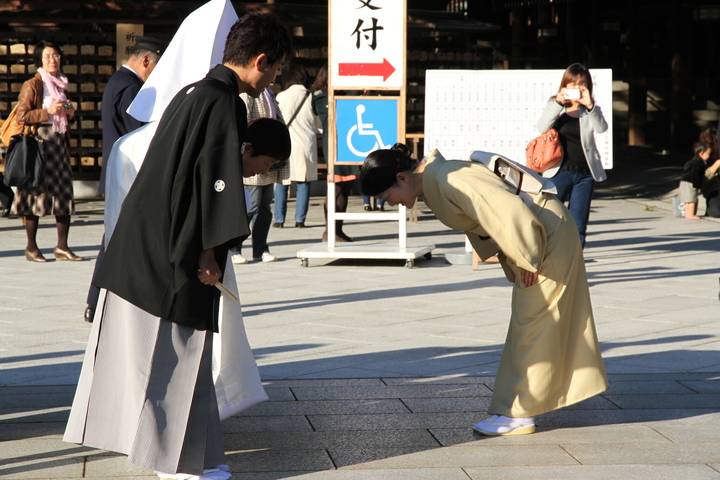
This gesture holds a spiritual undertone, serving as a silent reminder that all living entities possess identical intrinsic value, and that lowering the physical body is the supreme method to project absolute reverence toward another. Over the passage of generations, this sacred temple ritual evolved seamlessly into daily secular interactions, yet the core philosophy of “willingly lowering the self to elevate the peer” remains beautifully intact within modern Ojigi.
During the Tokugawa Shogunate (Edo Period, 1603-1868), the state elevated Neo-Confucianism to the rank of official social ideology to govern the populace. Confucian doctrine heavily emphasized “Ritual Propriety” (Li) alongside rigid hierarchical structures: the sacred dynamics between ruler and subject, father and child, husband and wife. During this epoch, the art of bowing was systematically standardized as an instrument to clearly define and preserve social standing.
The Way of the Warrior: Bushido and Kinetic Discipline
The martial elite, the Samurai, played a defining role in shaping the strict, elegant rules of Japanese bowing. From identifying who must initiate the greeting, calibrating the exact degree of the inclination, to measuring the precise duration of the pause—every variable was calculated with mathematical discipline within the warrior class before diffusing across civil society.
The bow moved past the definition of a personal habit, transforming into an absolute moral obligation necessary to preserve national harmony. These centuries of structured discipline permanently etched the habit of physical inclination into the Japanese domestic fabric, transmitted seamlessly across generations.
2. The Anatomy of Ultimate Trust: Exposing the Vulnerable Path
Within feudal Japan, the execution of Ojigi carried a deep meaning intrinsically tied to survival and structural security. When a samurai bowed deeply before an associate or adversary, they willingly and consciously exposed the back of their neck—the single most vulnerable, fatal anatomical coordinate on the human body.
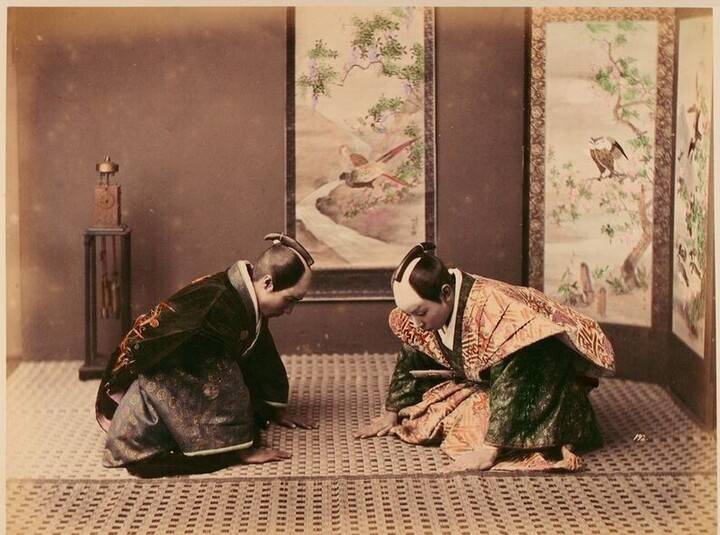
This stood as the absolute zenith of interpersonal trust. By lowering their head, historical figures transmitted a clear, silent message: “I harbor zero hostile intent, and I operate under the absolute belief that you will not violate my physical safety.”
In a society where sword-bearing warriors dominated daily spaces, an impeccably executed bow was the most efficient diplomatic tool to instantly neutralize ambient tension, establishing an unspoken, immediate non-aggression pact between both parties.
3. The Art of Distanced Intimacy: Honoring the Sovereign Space
While Western civilizations typically prioritize direct physical contact—such as firm handshakes, embraces, or casual shoulder contact—Japanese society masterfully maintains a sacred boundary of personal space during social interactions. This represents a highly sophisticated method of exalting individual privacy.
The bow offers a flawless solution: projecting profound warmth and sincerity while preserving an elegant, poised distance entirely free from physical contact. This becomes intensely meaningful within a culture that exalts social discretion and sensitivity. The foundational philosophy of Wa—the art of absolute social harmony—serves as the permanent guiding light for all community interactions.
Under this cultural lens, the Ojigi possesses the power to instantly “decompress” any confrontation, establishing a tranquil, highly receptive arena for dialogue. When two individuals bow in unison, they synchronize their micro-movements, forming a shared kinetic circle that dissolves potential social friction. It is an unyielding message of peace: “I approach you with an open heart, and I anticipate a deeply meaningful exchange.”
4. The Honor of Accountability: The Silent Dialect of the Shame Culture
In Japan, the bow is also deployed as a silent yet immensely powerful language to express deep accountability and remorse when operations do not perform to expectations. The traditional “shame culture” is deeply woven into the collective consciousness, where any negative impact inflicted upon another is viewed as a significant personal failure. When errors occur, whether by an individual executive or an entire corporate syndicate, bowing deeply remains the most authoritative method to articulate sincere regret.
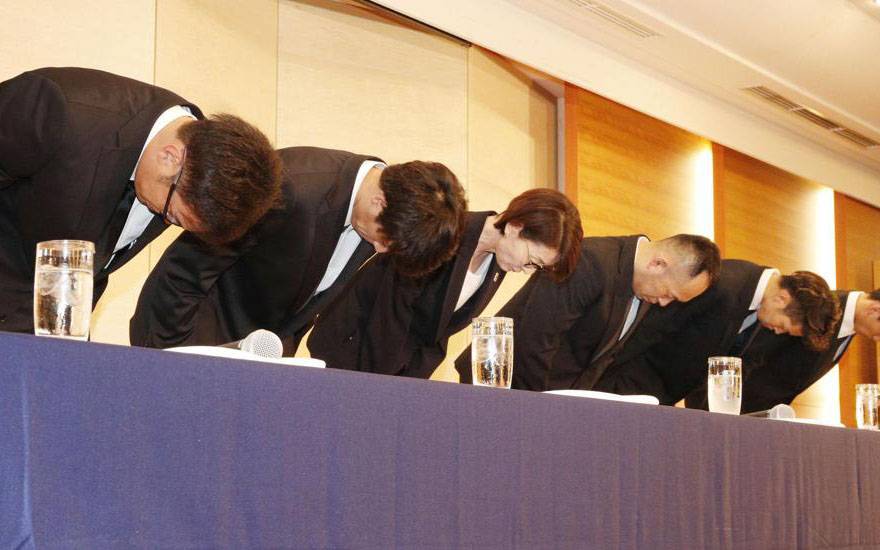
Rather than descending into lengthy verbal justifications or attempting to shift blame to external variables, the Japanese execute a simple yet profound gesture: lowering the body deeply and maintaining that exact position for a calculated duration to prove absolute sincerity. This kinetic posture confirms that they completely accept responsibility for the failure and stand ready to absorb the consequences.
At the highest levels of global enterprise, a synchronized bow of accountability is not a public relations script; it is an ironclad declaration of honor.
During high-profile corporate press conferences, international media often witness entire executive boards standing in a flawless line, bowing deeply to the level of the conference table. This is not a choreographed performance designed for media optics; it is a solemn oath of honor directed toward the community. Lowering the physical body communicates a deep, introspective remorse, an authentic request for collective forgiveness, and absolute proof that they prioritize their relationship with society far above any personal or corporate interest.
5. The Calibration of Caliber: Angles of Sophistication
The execution of Ojigi is a highly sophisticated method to acknowledge and exalt the standing of the peer. Whenever they bow, individuals perform a noble, selfless act: willingly lowering their own physical stature in that exact moment to elevate the other, whether addressing an honored client, a corporate superior, or an esteemed elder.
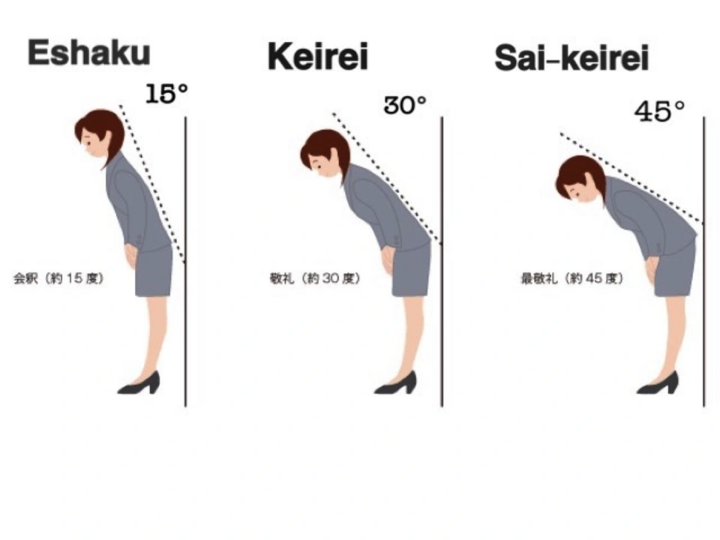
This societal order is masterfully reflected through three distinct angles of physical inclination:
                  [THE KINETIC HIERARCHY OF OJIGI]

         15° - Eshaku (The Casual Greeting)
        /      • For close associates, peers, and casual passing.
       /
      /  30° - Keirei (The Corporate Standard)
     /  /      • For clients, executive partners, and superiors.
    /  /
   /  /  45° - Saikeirei (The Zenith of Reverence)
  /  /  /      • For profound remorse, solemn rituals, and the sovereign.
-
Eshaku (15-Degree Angle): A light, transient inclination of the upper torso. This is typically reserved for familiar friends, daily colleagues, or casual passing greetings within social spaces.
-
Keirei (30-Degree Angle): The classical standard of the business ecosystem. This inclination is deployed when welcoming prestigious clientele, submitting reports to corporate directors, or entering high-stakes meeting rooms.
-
Saikeirei (45-Degree Angle): The absolute summit of physical and spiritual reverence. This profound inclination is strictly reserved for solemn state ceremonies, expressing deep, corporate-level accountability, or projecting absolute honor toward individuals commanding the highest positions in society.
This structured precision maintains social equilibrium, allowing each individual to navigate community interactions with predictable, balanced grace, preventing unnecessary friction within daily communication.
In Conclusion: The Quiet Magnificence of Living Honorably
The Japanese art of the bow reveals a timeless lesson to modern high society: true grandeur does not require booming proclamations or aggressive physical dominance to assert its caliber. On the contrary, it reveals itself through absolute self-control, elegant humility, and a profound respect for the sovereign space of others.
At Louis Phan and Phan Gia Jewelry, we recognize that this philosophy of quiet refinement perfectly mirrors the creation of bespoke high-jewelry masterpieces. Much like how a masterfully cut gemstone requires no loud vanity to validate its rarity—relying instead on its silent, unyielding internal fire—the Ojigi stands as an immortal monument to a lifestyle anchored in deep intellect, honor, and uncompromised elegance.
To live with grace is to recognize that the most powerful statement is often authored in the quietest moments of respect.
Louis Phan & Phan Gia Jewelry